
In this post, we’ll explain what “amortization” means and provide an amortization calculator to show the mortgage payoff schedule for any fixed-rate mortgage.
"Amortization” is the process by which a loan’s balance is paid down over time. In the case of a mortgage, there is one payment for each month of the loan term (say 30 years). Each time the borrower makes a payment, the loan balance is reduced, thereby amortizing the loan. After the full term, the loan has been completely amortized and the balance is $0.
To see how this works, try this interactive amortization calculator. We also provide a basic example and explain how the amortization table is calculated below.
Amortization calculator
Select loan term, loan amount, and interest rate to view the amortization table. You can view the graph by monthly payment (broken down into principal and interest) or total loan balance. The table provides the full amortization schedule for the selected year.1
Click anywhere on the amortization schedule calculator or select a different year to see the detailed payment amounts for that time in the loan term.
A basic example of amortization
Let’s say you take out a 30-year fixed-rate mortgage in the amount of $500,000, with a 3.500% interest rate. The amortization schedule calls for you to make 360 monthly payments of exactly $2,245.22.
Each of those monthly mortgage payments comprises principal and interest. While the total payment amount never changes over the 30-year term, the amount of the payment that goes to principal goes up with each subsequent payment, and the amount that goes to interest goes down.
The reason for this is the amortization of the loan balance. At the start of the term, the loan balance is $500,000. The amount of interest you owe in the first month is based on 3.500% (annually) of that balance. Your first monthly payment breaks down to $786.89 principal and $1,458.33 interest.
Once you make this payment, your loan balance goes down to $499,213.11. Since you pay interest only on the balance, you owe less interest. Therefore, in your second payment, $789.19 goes to principal and $1,456.04 goes to interest.
Each month, you chip away at the loan balance, with more money going to principal and less going to interest than the previous month. After 359 payments, $2,238.69 of your final payment will go to principal, and only $6.53 to interest, and your loan is fully amortized.
Amortization schedule formula
The amortization schedule for a fixed interest loan provides a month-by-month breakdown of:
- The monthly payment amount (stays the same each month)
- The amount that goes to principal (goes up each month)
- The amount that goes to interest (goes down each month)
- The loan balance (goes down each month)
In case you’re interested in how this is calculated, here is the formula:
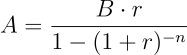
Where:
- A = total monthly payment
- B = current loan balance
- r = monthly interest rate – e.g., if your rate is 3.5% then:
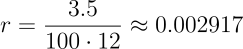
- n = number of remaining months
Since the numbers will not end up being even cents, rounding adds some more complexity. Every rate quote will include your monthly payment amount, and provide the info you need to calculate your amortization.
The amortization calculator is provided for demonstrative purposes only. ↩